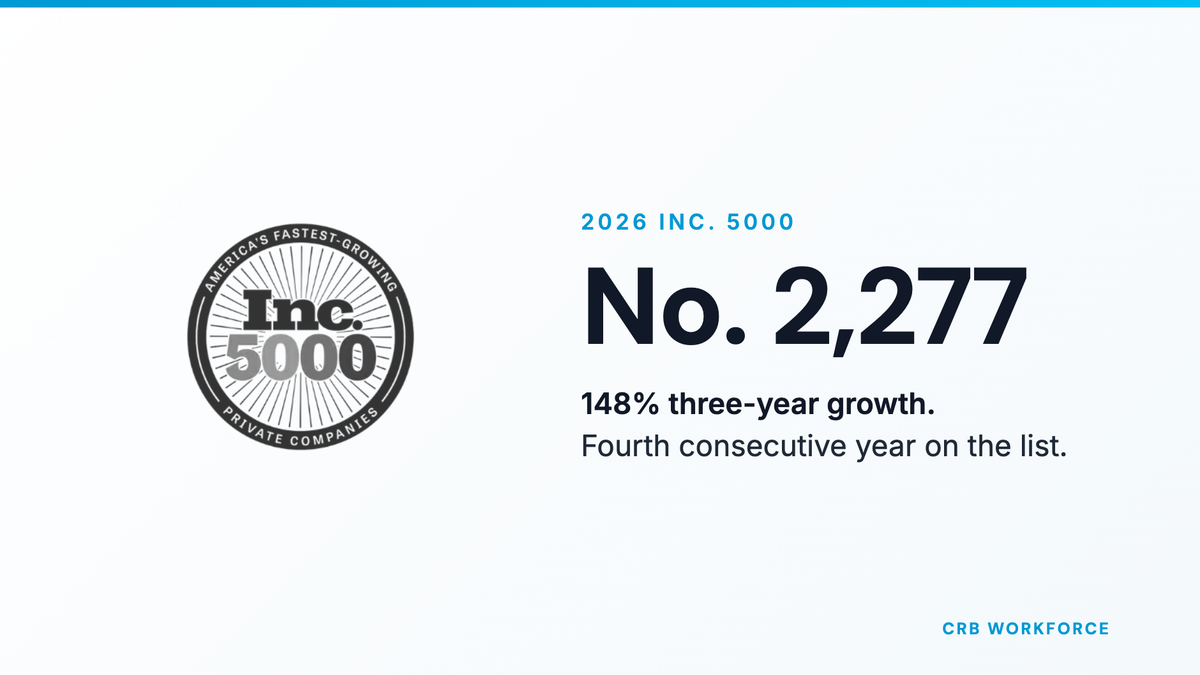
CRB Workforce has been named to the Inc. 5000 for the fourth consecutive year, ranking No. 2,277 on the 2026 list with 148% revenue growth over three years.
That is our strongest placement in four appearances. We came in at No. 2,775 in 2023, No. 3,336 in 2024 and No. 3,137 in 2025. This year we moved up 860 spots.
The full announcement went out over the wire this morning. Read it on PR Newswire, or as picked up by Morningstar.
Why a growth ranking is worth anything at all
Most awards in this industry are bought, voted on, or handed out for filling in a form. The Inc. 5000 is one of the few that is not. It ranks private American companies by one number: percentage revenue growth across three years. There is no panel, no nomination essay, no category to hide in.
Which makes it a useful signal, but not for the reason most companies use it in their marketing. Revenue growth in staffing is almost entirely a repeat-business number. New logos are expensive and slow. Growth that compounds for four straight years means the same clients came back with the next role, and the one after that, because the last placement worked out.
Put differently: you cannot grow a staffing firm 148% in three years on bad placements. The churn catches you by year two.
What actually drove the four years
Three things, and none of them are interesting enough to put on a billboard.
We stayed narrow. CRB Workforce places technology, product, data and marketing talent. That is it. We turned down the adjacent verticals that would have padded revenue faster, because a recruiter who covers everything covers nothing well. When a hiring manager asks us what a senior platform engineer costs in Austin right now, the answer comes from placements we made this quarter, not from a salary survey.
We got honest about cost. The last two years pushed a lot of hiring budgets sideways. Companies still needed to build, with less. That is what pushed us into nearshore delivery through CRB+, which puts vetted talent in aligned time zones at 40% to 60% below comparable US rates. It is not the right answer for every role. It is the right answer often enough that it changed what we could say yes to. We wrote about where nearshore staffing actually works and where it does not if you want the unvarnished version.
We competed on speed, not volume. The firms losing right now are the ones sending twelve resumes and hoping. Top candidates are off the market in under two weeks, so a shortlist of three you would actually hire beats a stack of twelve you have to read. That is also why we publish things like how long it really takes to hire a software engineer, because most hiring timelines fail on the client side, not the candidate side.
The part that matters to you
If you are choosing a staffing partner, growth rankings tell you one narrow thing: whether other companies kept buying. That is worth checking. It is not worth deciding on.
Better questions to ask any firm you are evaluating, including us:
- How many of your placements last year were repeat clients?
- What is your fill rate on roles like this one, and your average time to first submittal?
- Who exactly is sourcing the role, and how many other roles are they carrying?
- What happens to your fee if the placement does not make it to ninety days?
A firm that cannot answer those quickly is telling you something. We put our own numbers on the table early, which is also why we publish what an IT staffing agency actually costs instead of making you sit through a call to find out.
The ranking is a lagging indicator. The work that produced it is the thing we would rather be judged on.
What the Market Is Showing Right Now
The hiring environment continues to favor firms that can source specialized talent quickly. ManpowerGroup's 2026 survey of more than 39,000 employers across 41 countries found that 72% are struggling to fill open roles, while Robert Half reports that 61% of technology leaders plan to increase permanent tech headcount in the first half of 2026. On the marketing side, 65% of leaders plan to expand permanent headcount and 55% expect to increase contract or temporary hiring, with 45% saying skilled talent is harder to find than a year ago.
Working with CRB Workforce
We place engineering, product, data and marketing talent on contract, contract-to-hire and direct hire terms, for companies from seed stage to the Fortune 500. If you are weighing which of those models fits an open role, this breakdown of staffing agency versus direct hire is a good place to start. If you would rather just talk to someone, reach out and we will tell you honestly whether we are the right firm for the role.